Norway Rats in South Lake Tahoe — Uncommon, But Possible Near the Water
But "uncommon" isn't "impossible." Near the lake shoreline — especially around the Tahoe Keys lagoon edge — the habitat works for them. Burrowable soil, water access, and sheltered foundations. If you're on or near the water and you're finding large droppings or burrow holes along your foundation, it's worth a professional look.
If this is the animal in your home, our rodent removal in South Lake Tahoe starts with a free inspection — we confirm the species before we trap anything.
Here's what Norway rats are, how to tell if you've got them, and what we do about it.
Call (530) 203-0122 · Get Your Free Inspection
What Norway Rats Actually Are
Norway rats (Rattus norvegicus) — also called brown rats or sewer rats — are the big, heavy ground-dwellers of the rat world. Adults run 7 to 10 inches of body plus a thick, scaly tail. They're burrowers, not climbers. They dig tunnel systems under foundations, along banks, and beneath debris, then push up into structures through ground-level gaps.
Here's the thing — they're built for the coast and the valley floor, not for 6,225 feet in the Sierra. Cold, deep snow, and thin soils work against them. That's why they're rare up here. But the shoreline is the exception. Where the ground stays workable and water is close — the Tahoe Keys, lagoon edges, creek banks — a Norway rat can make it work.
They're also strong swimmers and they follow water. Any property near the lake with burrowable soil along the foundation is the highest-probability spot in South Lake Tahoe for Norway rats.
How to Tell Norway Rats From Mice
Size is the giveaway.
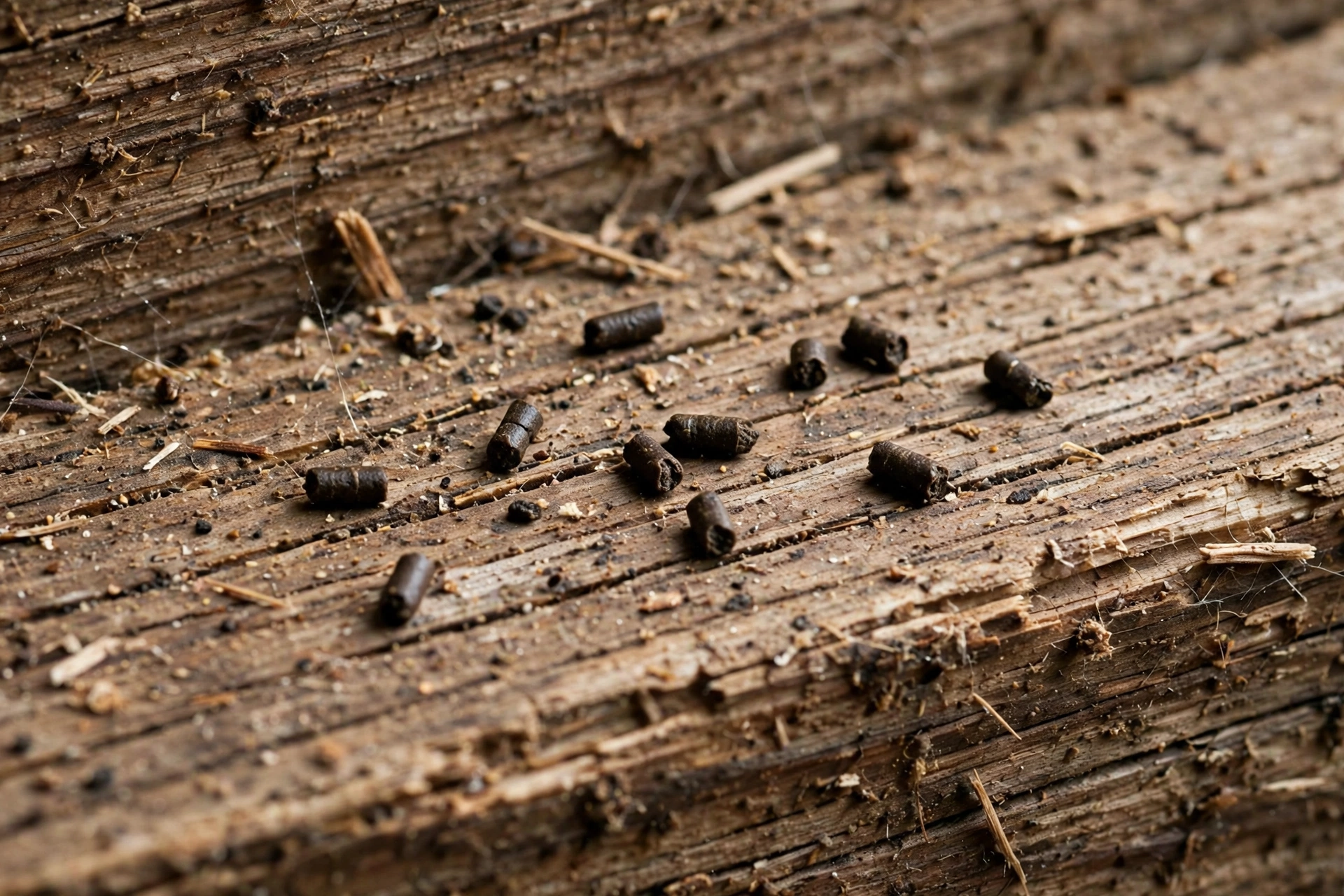
Droppings: Norway rat droppings are blunt-ended capsules about the size of an olive — roughly 3/4 of an inch long. Mouse droppings are the size of a grain of rice. If the droppings are olive-sized, you're not dealing with mice.
Burrows: Look for holes the size of a golf ball or larger along the foundation, under the deck, or along banks. Fresh burrows have smooth, packed dirt around the entrance. Mice don't burrow like this — burrow holes mean rats.
Rub marks: Norway rats stay low, so their greasy rub marks show up along baseboards, foundation walls, and the bottoms of fences — not up in the attic. If the marks are at ground level, that points to Norway rats. Marks in the attic point to mice.
Gnaw marks: Bigger. Norway rats gnaw through wood, plastic, and even soft metals. Their gnaw marks are wider and deeper than mouse gnawing.
Behavior: Norway rats are nocturnal and cautious. You might hear heavy scurrying in the crawlspace or under the floor — not the light scratching of mice in the attic. They're ground-floor animals: crawlspaces, garages, basements, under decks.
If We Find Them, Here's the Plan
We're not going to pretend Norway rats are common here. But if the inspection turns up burrows, olive-sized droppings, or ground-level rub marks, here's exactly what we do:
1. Free inspection with species ID. We confirm it's Norway rats and not something else. Burrow mapping — we find every active burrow hole around the foundation and property. Photo documentation of all signs.
2. Burrow treatment and trapping. Active burrows get treated directly. We set heavy-duty snap traps along confirmed ground-level travel paths — along foundation walls, fence lines, and burrow runs. Exterior tamper-resistant bait stations, locked and secured. No loose poison inside your house. Ever.
3. Ground-level exclusion. This is different from mouse exclusion. Norway rats push through bigger gaps — broken vent screens, gaps under doors, openings around ground-level pipes, cracked foundation vents. We seal with steel mesh, hardware cloth, metal flashing, and cement around sewer and water line penetrations. Burrow-prone areas get hardware cloth buried along the foundation line.
4. Habitat correction. We'll tell you straight what to fix: debris piles against the foundation, overgrown vegetation along the house, accessible pet food or bird seed, standing water. Norway rats need food, water, and burrow cover. Remove those and the property stops being attractive.
5. Monitoring. Scheduled return visits to check bait stations and sealed entry points. Activity between visits? Free re-treatment.
What Norway Rat Removal Costs
| Service | Price | What You Get |
|---|---|---|
| Inspection | Free | Full property walkthrough, species ID, burrow mapping, written report with photos |
| One-Time Rodent Removal | Starting at $199 | Trapping + 2 follow-up visits to clear the house |
| Removal + Full Exclusion | Starting at $349 | Trapping + sealing every entry point on your home |
| Monthly Protection | $49–$59/month | Scheduled visits, exterior bait stations, monitoring, free re-treatment |
| Attic Cleanup & Restoration | Custom quote | Insulation removal, sanitization, re-insulation |
Exact price after the free inspection. Norway rat jobs involving burrow work can run higher on the exclusion side — we'll give you the real number up front.
Why DIY Fails Against Norway Rats
They're bigger, stronger, and warier than mice
A Norway rat can chew through plastic, soft wood, and cheap vent screens that would stop a mouse cold. Store-bought traps are often too small — a rat can steal the bait without triggering a mouse-sized trap, or worse, get injured and become trap-shy. We use rat-rated traps placed on confirmed runways.
Burrows are a system, not a hole
You fill one burrow hole, they dig out three feet away. A Norway rat burrow system has multiple entrances and escape tunnels. DIY fills the visible hole and declares victory. We map the whole system, treat the active burrows, and seal the structural entry points so they can't re-establish.
Poison near the shoreline is irresponsible
A poisoned rat near the lagoon or lake edge becomes a poisoned meal for owls, hawks, and other wildlife. Secondary poisoning is real. We use locked exterior stations placed with shoreline awareness, and interior-equivalent work is done with traps — not loose bait.
The Damage Norway Rats Cause
Foundation and structural gnawing. They chew through wood, plastic vent screens, and soft materials at ground level. Over time, that compromises vents, siding, and access panels.
Burrowing under foundations and slabs. Tunnel systems can undermine walkways, patios, and shallow foundations. Not common in a single season, but an established burrow system does real damage.
Contamination. Norway rats carry leptospirosis, salmonella, and other diseases. Their droppings and urine contaminate crawlspaces, garages, and anywhere they travel regularly.
Wiring. Like all rodents, their teeth grow continuously and they gnaw to file them down — including electrical wiring in crawlspaces. Exposed wire in a crawlspace is a fire risk.
Norway Rat FAQs
How much does Norway rat removal cost in South Lake Tahoe?▾
One-time removal starts at $199 — inspection, trapping, two follow-ups. Removal plus full exclusion starts at $349, though burrow-heavy jobs can cost more on the sealing side. Monthly protection is $49 to $59 a month. You get the exact price after the free inspection.
Are Norway rats common in South Lake Tahoe?▾
No. They're uncommon at this elevation. The one exception is near the lake shoreline — particularly around the Tahoe Keys lagoon area — where burrowable soil and water access make the habitat workable. Everywhere else in the basin, a "rat" problem is almost always deer mice.
How do I know if I have Norway rats or just mice?▾
Droppings are the fastest tell. Olive-sized and blunt-ended means rats. Rice-grain-sized means mice. Burrow holes along the foundation — golf-ball sized or bigger — mean rats; mice don't dig burrow systems. We confirm the species free during the inspection.
Where would Norway rats be in my house?▾
Ground level. Crawlspaces, garages, under decks, along foundation walls. They don't climb into attics like roof rats — they're burrowers. If all the signs are upstairs, it's not Norway rats.
Are they dangerous?▾
They can carry leptospirosis, salmonella, and other diseases through their droppings and urine. They're also destructive — gnawing, burrowing, contaminating. They're not aggressive toward people, but they don't belong in or under your house.
Do you use poison?▾
Interior work is traps only — no loose poison inside your house, ever. Exterior tamper-resistant bait stations are locked boxes. Near the shoreline, we're careful about placement to protect wildlife.
Will they come back?▾
Not through anything we sealed. Burrow-prone areas get hardware cloth along the foundation line. And if activity shows up between scheduled visits, we re-treat free.
Think You've Got Rats Near the Water? Get a Free Inspection.
We'll come out, identify exactly what you're dealing with — rats, mice, or nothing at all — and give you a straight plan.
Call (530) 203-0122 · Schedule Your Free Inspection
Free Species ID · Burrow Mapping · Rodent-Free Guarantee