Deer Mice in South Lake Tahoe — The #1 Rodent at 6,225 Feet
They're in the forest around your house. They're in your garage. And when the heavy snow hits in October, they're in your walls. Here's what you're dealing with, how to spot them, and how we get rid of them.
If this is the animal in your home, our rodent removal in South Lake Tahoe starts with a free inspection — we confirm the species before we trap anything.
Call (530) 203-0122 · Get Your Free Inspection
What Deer Mice Actually Are
Deer mice (Peromyscus maniculatus) are native to the Sierra Nevada. They've lived in these mountains far longer than any house has stood here. They're small — 3 to 4 inches of body plus a long tail — nocturnal, and incredibly abundant in the forest duff, underbrush, and rocky areas around South Lake Tahoe.
Here's the thing — they're not coming from somewhere else. They live on your lot. Under your deck, in the wood pile, in the brush along the fence. Your house is just the warmest, driest part of their territory. When the temperature drops and the snow piles up from October through March, moving indoors isn't a choice for them. It's survival.
A single property in the Tahoe basin can support dozens of deer mice in the surrounding vegetation. That's why trapping alone never works up here — the outside population is effectively infinite. The only thing that works is sealing the house.
How to Tell a Deer Mouse From a House Mouse
This matters, because the cleanup rules are different.
Deer mice have big dark eyes, large ears, a white belly with brownish-gray fur on top, and a distinctly bicolored tail — dark on top, white underneath. They're slightly larger than house mice and look, frankly, a little cuter. Don't let that fool you.
House mice are smaller, uniformly gray-brown all over, with a thin tail that's all one color.
Why does the ID matter? Hantavirus. Deer mice are the primary carrier of Sin Nombre hantavirus in the western US. Their droppings, urine, and nesting material can carry the virus, which becomes airborne when dry droppings are disturbed. That's why the cleanup protocol for deer mice is strict: wet disinfection, masks, gloves — never sweeping or vacuuming dry droppings. House mouse droppings are unsanitary too, but they don't carry the same hantavirus risk.
We identify the species free during every inspection. If you've got deer mice, we handle the cleanup to hantavirus-safe standards.
Hantavirus: What You Actually Need to Know
Let's be straight about this. Hantavirus pulmonary syndrome is rare but serious. It kills a significant percentage of the people who develop it. And deer mice are the carrier.
How people get exposed: Breathing in dust contaminated with deer mouse urine or droppings. This happens when dry droppings are swept, vacuumed, or disturbed in an enclosed space — a cabin that's been closed all winter, an attic, a crawlspace, a storage shed.
The critical rule: Never sweep or vacuum deer mouse droppings dry. Ever. Spray them with disinfectant until they're soaked, let it sit, then wipe them up with paper towels while wearing gloves and a mask. For heavy contamination — a winter's worth of nesting in an attic — don't do it yourself. Call us. We do hantavirus-safe cleanup with commercial-grade disinfectant and proper protective equipment.
The good news: Hantavirus doesn't spread person to person, and simple precautions make cleanup safe. Wet everything down, wear a mask, wear gloves, ventilate the space. It's not complicated. It just has to be done right.
Signs of Deer Mice in Your Home
- Scratching or scurrying at night in walls, ceilings, or under floors — they're nocturnal
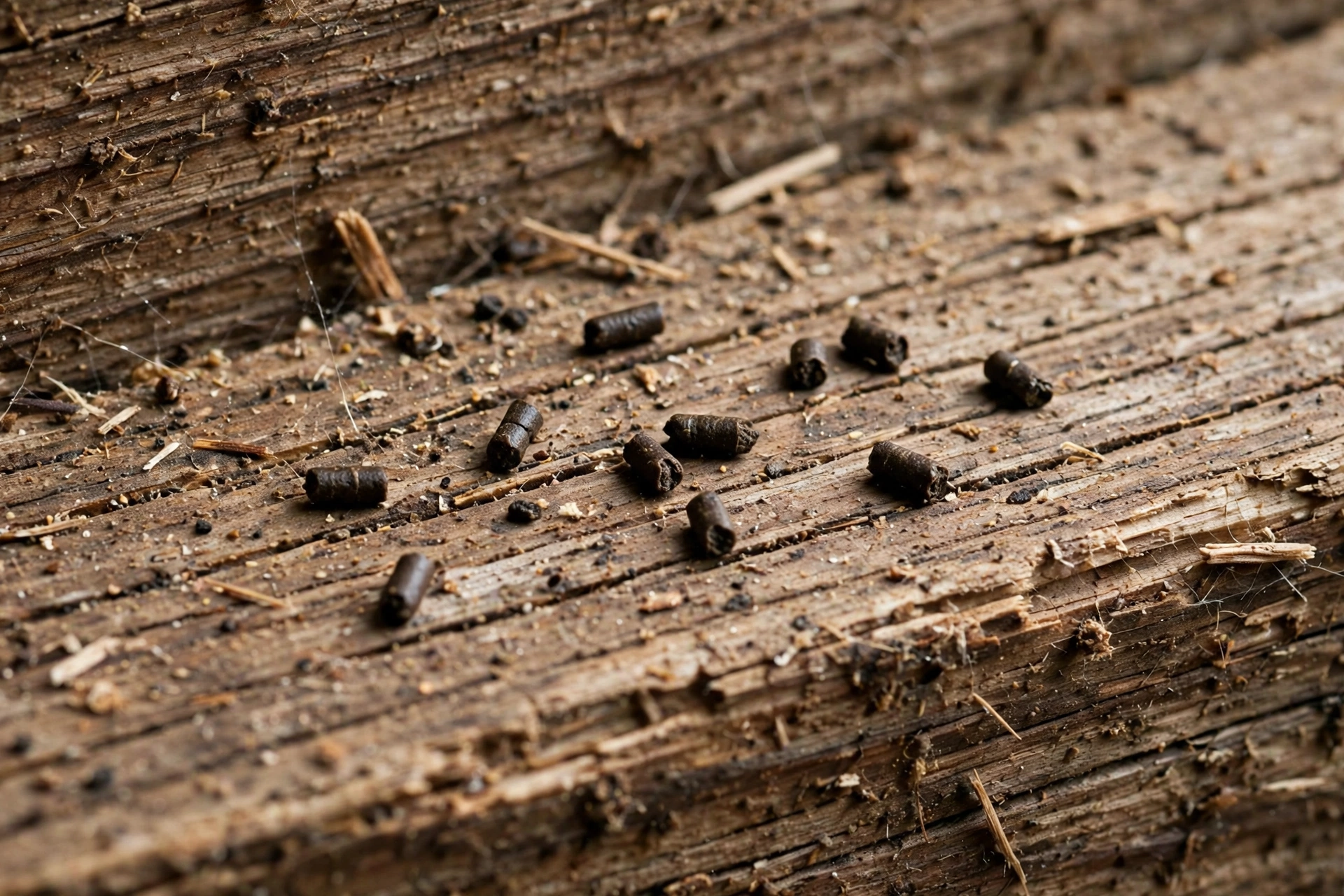
- Droppings along baseboards, in drawers, behind appliances, in the garage — rice-grain sized with pointed ends
- Nesting material: shredded insulation, paper, fabric, plant matter stuffed into corners and wall voids
- A musty, ammonia smell in the attic or crawlspace
- Chewed food packaging, pet food bags, stored items
- Caches of seeds or pet food stashed in hidden spots — deer mice hoard food
- Activity that spikes with the first heavy snow in October
Our Approach to Deer Mice
1. Free inspection with species ID. We confirm it's deer mice (and not house mice, woodrats, or anything else), map every entry point, and photograph all signs of activity.
2. Trapping along travel paths. Professional snap traps placed where the droppings and rub marks tell us they run — along walls, in the attic, behind stored items. Locked exterior bait stations. No loose poison inside. Ever.
3. Full exclusion. This is the part that matters most with deer mice, because the forest keeps sending more. Steel mesh over vents, metal flashing at the roofline, sealant and steel wool around every penetration. We seal down to a quarter inch.
4. Hantavirus-safe cleanup. Contaminated insulation comes out. Affected areas get soaked with commercial-grade disinfectant. We wear masks and gloves, and we don't cut corners — because with deer mice, cutting corners on cleanup is a health risk.
5. Monitoring. Scheduled visits. Free re-treatment if activity comes back between visits.
What Deer Mouse Removal Costs
| Service | Price | What You Get |
|---|---|---|
| Inspection | Free | Full property walkthrough, species ID, written report with photos |
| One-Time Rodent Removal | Starting at $199 | Trapping + 2 follow-up visits to clear the house |
| Removal + Full Exclusion | Starting at $349 | Trapping + sealing every entry point on your home |
| Monthly Protection | $49–$59/month | Scheduled visits, exterior bait stations, monitoring, free re-treatment |
| Attic Cleanup & Restoration | Custom quote | Insulation removal, hantavirus-safe sanitization, re-insulation |
Exact price after the free inspection.
Why DIY Fails Against Deer Mice
The forest is an unlimited supply
You can trap ten deer mice from your garage and the woods send ten more. DIY trapping without exclusion is a hobby, not a solution. We seal the house so the outside population stops mattering.
Dry cleanup is dangerous
This is the one that worries us most. Homeowners find droppings in a cabin that's been closed all winter, grab a broom, and sweep. That puts hantavirus-contaminated dust in the air. If you find significant deer mouse droppings, wet them down with disinfectant first — or better yet, call us and let us handle it.
They're cautious around new objects
Deer mice are wary of unfamiliar traps placed in unfamiliar spots. Store-bought snap traps in the middle of the floor get ignored. We place traps along confirmed travel paths based on sign reading — droppings, rub marks, gnaw patterns. Placement is the whole game.
A Note on Woodrats (Pack Rats)
If you're in a forested part of South Lake Tahoe — Highland Woods, the Gardner Mountain side, cabins tucked in the pines — you might also run into bushy-tailed woodrats. They're bigger than deer mice, with bushy tails, and they build large stick nests under cabins, in wood piles, and in sheds. They collect shiny objects and chew wiring just like mice do.
Woodrats are a different animal with different habits, and the approach is different. We identify them during the inspection and adjust the plan. If you find a stick nest under your cabin, don't just clear it — call us first so we can assess what's living in it.
Deer Mouse FAQs
How much does deer mouse removal cost in South Lake Tahoe?▾
One-time removal starts at $199 — inspection, species ID, trapping, two follow-ups. Removal plus full exclusion starts at $349. Monthly protection is $49 to $59 a month. Cleanup is a custom quote. Real number after the free inspection.
Can deer mice really make me sick?▾
Their droppings can carry Sin Nombre hantavirus, which causes a rare but serious lung illness. Exposure happens when dry, contaminated droppings are disturbed and the dust is inhaled. The prevention is simple: never sweep or vacuum dry droppings — wet them with disinfectant first, wear a mask and gloves. For heavy infestations, let professionals handle the cleanup.
I found droppings in my cabin after winter. What should I do?▾
Don't sweep them. Open windows to ventilate, put on a mask and gloves, spray the droppings with disinfectant until soaked, wait several minutes, then wipe up with paper towels. If there's a lot — nesting material, heavy contamination across the attic or cabin — call us. We'll do it to hantavirus-safe standards.
How do deer mice get in?▾
Any gap a quarter inch or wider. Vents, pipe penetrations, gaps under doors, cracks in the foundation, openings where utilities enter. In the Sierra, they also come down from the roofline and in through eave gaps. We find and seal every one.
Why do I only see them in winter?▾
Because that's when they move indoors. Heavy snow from October through March drives them out of the forest and into warm structures. They're active outside year-round, but your house only becomes critical habitat when it's 15 degrees out.
Are deer mice worse than house mice?▾
Different risks. House mice breed faster and contaminate food. Deer mice carry hantavirus. Both chew wiring — which is a fire risk — and both destroy insulation. Neither belongs in your house.
Will they come back after treatment?▾
Not through anything we sealed. Exclusion is permanent as long as the seals hold, and we warranty our exclusion work. Monthly protection adds ongoing monitoring through the snow season.
Do you use poison for deer mice?▾
Interior work is done with snap traps — no loose poison inside your house, ever. Exterior tamper-resistant bait stations are locked boxes placed outside. That's it.
Don't Sweep Those Droppings. Call Rodent Killer.
We'll come out, identify what's in your house, handle the cleanup safely, and seal it up so they can't come back.
Call (530) 203-0122 · Schedule Your Free Inspection
Hantavirus-Safe Cleanup · Free Inspection · Rodent-Free Guarantee