Dead Animal Smell in Your Home — South Lake Tahoe, CA
Something died in your house. When a rodent dies inside a wall cavity, your attic, or under the house, the smell doesn't go away fast. We find the animal, remove it, and treat the area so the odor actually goes away — not covered up, gone.
If the smell is the problem, start with our dead animal smell removal in South Lake Tahoe — we find the source, remove it, and treat the odor.
Call (530) 203-0122 · Free Inspection
Why Dead Rodents Smell So Bad
A dead mouse or rat decomposes through bacterial breakdown. As the body breaks down, it releases gases — sulfur compounds, methane, and organic acids. That's the smell. It's not toxic at the levels in a typical home, but it's intense, and it gets worse before it gets better.
How Long Does It Last?▾
Here's the honest timeline:
- Small mouse, cool conditions — 1 to 2 weeks
- Rat or larger mouse — 2 to 4 weeks
- Any rodent in a wall cavity or enclosed space — longer, because airflow is restricted
- Multiple dead animals — each one has its own timeline, so it can drag on for weeks
In South Lake Tahoe, there's a seasonal twist most people don't expect. A mouse that dies inside an exterior wall in January may decompose slowly in the cold — and then the smell hits hard in spring when temperatures rise and things thaw out. Second-home owners open their cabins in May and get punched in the face by a smell that's been building since December.
You can wait it out. Eventually decomposition finishes and the smell fades. But "eventually" can mean a month or more of a nauseating odor in your house. Most people would rather deal with it now.
Why We Don't Use Loose Poison Indoors
This is the part most people need to hear.
The most common reason a dead animal ends up inside a wall is poison. Someone — you, a previous owner, a pest company — put out rodenticide. The mouse ate it, went back to its nest to rest, and died there. If that spot is inside a wall cavity, you now have a dead mouse in your wall.
This is exactly why we don't put loose poison bait inside homes. You can't control where a poisoned rodent goes to die — a wall, behind the dishwasher, inside your HVAC ductwork where the smell blows through the whole house every time the heat kicks on.
We use snap traps indoors, placed along confirmed travel paths, so we control exactly where the animal dies. Locked, tamper-resistant bait stations go on the exterior only.
Other Reasons Dead Rodents End Up in Walls and Attics
Natural death. Mice live 1 to 2 years. A deer mouse living in your attic or wall voids may simply have died of old age in its usual hiding spot.
Trapped inside. If someone sealed an entry point without trapping first, rodents already inside get stuck in wall cavities with no way out. They die within days. This is why we always trap BEFORE we seal.
Winter die-off. Deep Tahoe winters kill mice too — especially ones sealed inside an unheated cabin during a cold snap. A mouse that dies in January behind a wall in a vacant cabin won't announce itself until someone opens the door in spring.
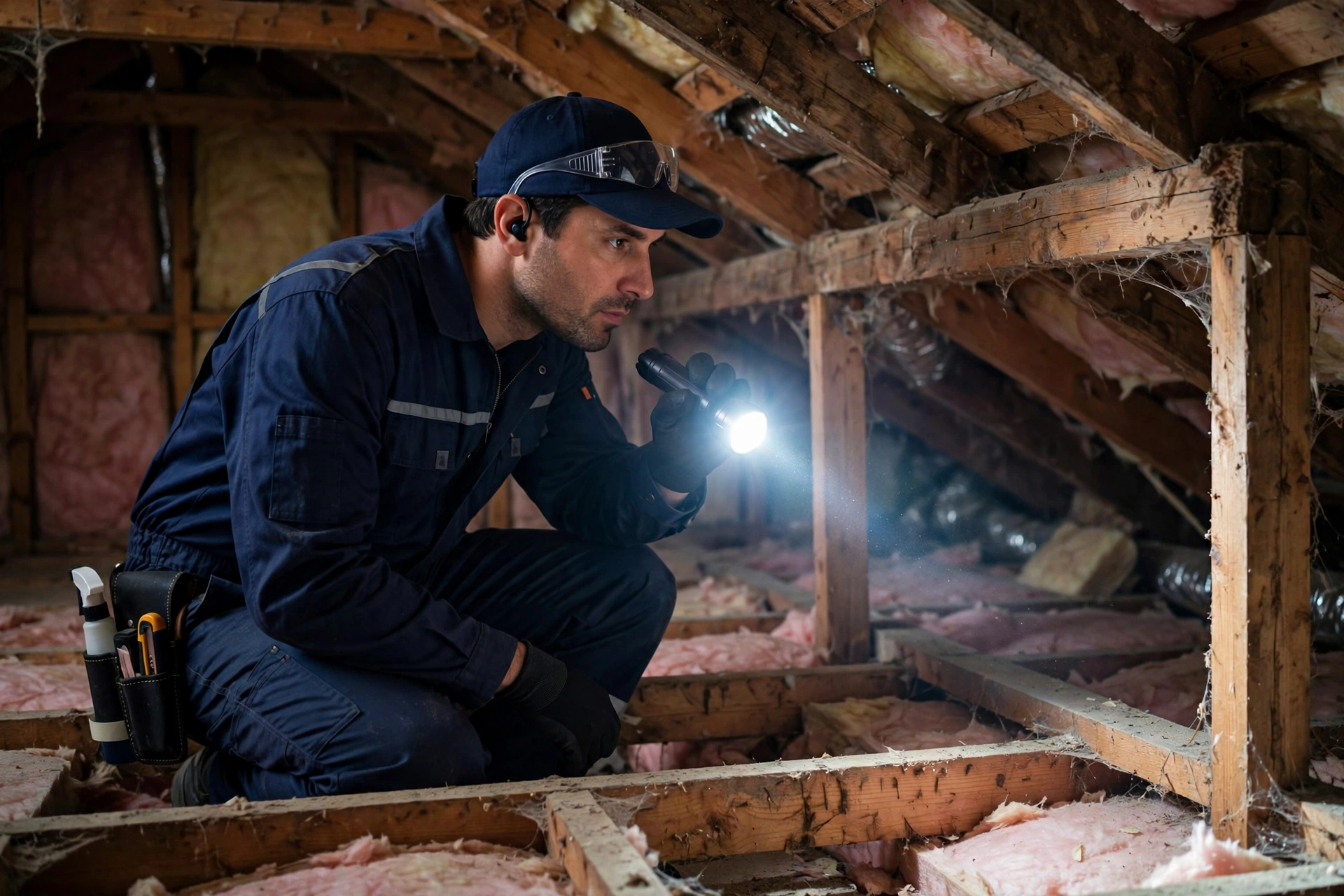
How We Find and Remove Dead Rodents
The Challenge
Dead rodents don't die in convenient places. They die in:
- Wall cavities — between drywall and exterior sheathing. No access without cutting.
- Attic insulation — buried under blown-in cellulose or wedged into fiberglass batts.
- Crawlspaces — under the house, wedged against ductwork or floor joists.
- Behind cabinetry — kitchens and baths, against exterior walls.
- Inside HVAC ductwork — the furnace pushes the smell through every register in the house.
How We Locate Them
Nose. An experienced tech can follow the odor gradient room to room and narrow it to a specific wall or cavity.
Visual clues. Decomposition fluids can stain drywall. And flies are the big tell — flies cluster near the source. A sudden fly problem in one room usually means something dead in or near that wall.
Thermal detection. In some cases, a thermal camera can pick up the slight temperature difference of a decomposition hotspot behind drywall.
Removal
- Accessible (attic, crawlspace, behind an appliance) — we remove the animal, bag it, and sanitize the area.
- Wall cavity — we cut a small access hole (usually 4 to 6 inches), remove the animal, sanitize the cavity, and patch the hole or leave it clean for your handyman.
Odor Treatment — Getting Rid of It for Real
Removing the animal is step one. But decomposition fluids have soaked into the surrounding wood, insulation, and drywall. The smell won't stop the moment the animal comes out. Here's how we treat it:
1. Source cleanup — Remove the animal and any contaminated insulation or debris around it.
2. Enzyme-based disinfectant — A commercial-grade enzyme cleaner that chemically breaks down the organic compounds causing the odor. Not air freshener. Not Lysol.
3. Odor neutralizer — A secondary treatment that targets airborne odor molecules in the cavity and surrounding area.
4. Seal and ventilate — We seal the treated cavity and allow ventilation to clear residual odor. Most homes notice a dramatic improvement within 24 to 48 hours.
Why DIY Odor Fixes Don't Work
We've watched a lot of people try to power through this on their own. Here's how it usually goes:
They spray air freshener. The smell comes right back. Because the source — the dead animal and the fluids it's leaking — is still there. You're perfuming a problem, not solving it.
They can't find it. The smell seems to come from "somewhere in the kitchen" but three cabinets get torn apart and there's nothing — because it's inside the wall behind the cabinets. Most homeowners stop here and just live with it.
They wait it out. This technically works. In 3 to 8 weeks. Meanwhile you're hosting dinner with that smell in the house and the flies are getting worse.
They use more poison. Thinking there must be more of them. There might be — but poison is what created this problem in the first place. Each poisoned rodent is another potential dead animal in a wall.
Dead Animal Smell FAQs — South Lake Tahoe
How much does dead rodent removal cost?▾
The dead animal location and removal service starts within our standard removal pricing — one-time rodent removal starts at $199, which includes locating the source and the inspection. Removal plus full exclusion starts at $349, and monthly protection plans run $49–$59/month. If it requires cutting into a wall, we'll tell you that upfront. Exact price depends on accessibility.
Is the smell dangerous?▾
For most people, no. The gases are unpleasant but not toxic at household concentrations — though people with asthma or respiratory conditions can be more sensitive. The flies attracted to the animal can become a secondary problem.
Will there be a hole in my wall?▾
If the animal is inside a wall cavity, we may need to cut a small access hole — typically 4 to 6 inches. We can patch the drywall or leave it clean for your handyman. We keep the hole as small and discreet as possible.
Can the smell come back?▾
If there's one dead animal and we remove and treat it, the smell resolves.
I haven't had any rodent problems. Why does something smell dead?▾
You may have had a problem you didn't know about — very common with vacant cabins and second homes. Or a bird, squirrel, or other animal may have entered through a vent or chimney gap. We'll identify the animal and check for signs of a bigger issue during the visit.
Do you handle this for second homes I don't live in?▾
Absolutely. This is one of the most common calls we get from absentee owners. You open the cabin in May, something smells terrible, and you need someone there now. Call us and we'll get in, find it, and handle it.
Don't Live With the Smell
We'll find it, remove it, and treat the area so the odor is gone — usually in a single visit.
Call (530) 203-0122 · Free Inspection · Same-Day or Next-Day Service