House Mouse Removal in South Lake Tahoe — Small Gaps, Big Families
House mice are the second most common rodent in South Lake Tahoe — right behind deer mice. They're smaller, they breed faster, and they're the ones raiding your pantry and nesting behind your water heater. Here's how to spot them and how we get rid of them.
If this is the animal in your home, our rodent removal in South Lake Tahoe starts with a free inspection — we confirm the species before we trap anything.
Call (530) 203-0122 · Get Your Free Inspection
What House Mice Actually Are
House mice (Mus musculus) are the classic indoor mouse — small body, 2 to 4 inches long, uniformly gray-brown fur, pointy nose, big ears relative to their head, and a thin, nearly hairless tail. Unlike deer mice, they don't have a white belly or a bicolored tail. They're all one color, all business.
Here's the thing about house mice — they evolved to live with humans. They don't just visit houses. They colonize them. A house mouse is comfortable living its entire life inside your walls, never going outside, eating your food and nesting in your insulation. Deer mice come in from the forest for winter. House mice move in and stay.
And they breed like nothing else in your house. Gestation is about 19 to 21 days. Litters run 5 to 6 pups on average, and a female can produce 5 to 10 litters a year. Do the math: a single pair can produce 60+ offspring in a year, and those offspring start breeding at 6 weeks old. That "one mouse" you saw in the kitchen is never one mouse. It's a colony with a head start.
Where House Mice Nest in South Lake Tahoe Homes
Pantries and kitchens. Behind the stove, under the sink, inside the pantry behind the cereal boxes. They shred packaging and contaminate everything they touch. If you've got droppings in a kitchen drawer, you've got house mice.
Garages. The number one house mouse zone. Stored boxes, pet food bags, bird seed, grass seed — it's all food and nesting material. They nest behind the water heater, inside stored furniture, and in the walls between the garage and the house.
Wall voids. They travel inside walls along plumbing and electrical runs, which is why you hear scratching in the bedroom wall at 2 AM. The wall void is their highway system.
Attics and crawlspaces. Less common than deer mice up there, but house mice absolutely use attics — especially the insulation near the eaves where it's warm.
Winter Entry Points in South Lake Tahoe
Heavy Sierra snow from October through March pushes every rodent toward warmth, and house mice are already living close to humans — so they're the first ones in. Here's where they get through:
Garage door seals. The most common entry point, period. The rubber weatherstripping wears out, leaving a gap along the bottom. A quarter inch is enough. Walk out to your garage and look — if you can see daylight under the door, mice are using it.
Dryer vents. The vent flap that was supposed to close doesn't anymore. Or it never had a proper cover. Warm air pours out, mice walk in.
Utility penetrations. Every pipe and wire that enters your house goes through a hole. Cable lines, AC lines, water lines, gas lines. Most of those holes were never sealed, or the sealant cracked years ago. Mice follow the pipe straight in.
Doors. Exterior doors with worn sweeps. Sliding doors with gaps in the track. The door to the garage that doesn't quite latch.
Foundation cracks and vents. Crawlspace vents with chewed or missing screens. Cracks in the foundation from freeze-thaw cycles.
We check every one of these during the free inspection. Most South Lake Tahoe homes have at least three or four active entry points. Older homes have more.
Signs of House Mice
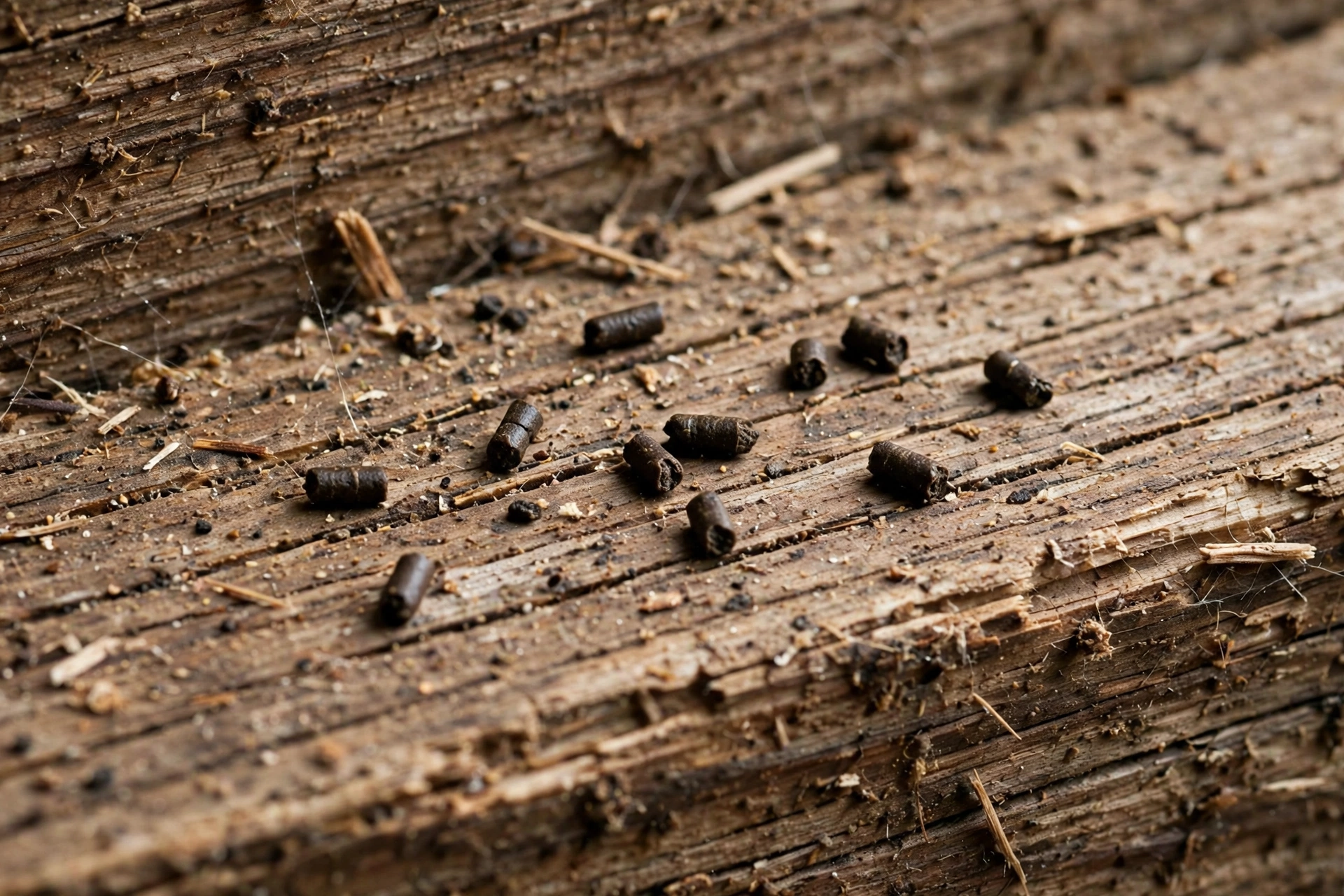
- Droppings in kitchen drawers, along baseboards, on garage shelves — the size of a grain of rice
- Chewed food packaging, especially cereal, pet food, and bird seed bags
- Scratching or scurrying inside walls at night
- Nesting material: shredded paper, fabric, insulation in hidden corners
- A musty smell in the pantry or under the sink
- Gnaw marks on baseboards, food containers, and stored items
- Your cat staring at the same spot on the wall for an hour
Our Approach to House Mice
1. Free inspection. Full property walkthrough — attic, crawlspace, garage, kitchen, every vent and penetration. We identify the species (house mouse vs. deer mouse matters for cleanup protocol) and photograph every entry point.
2. Trapping along travel paths. Professional snap traps placed where the droppings tell us they run — along wall edges, behind appliances, in the garage. Locked exterior bait stations. No loose poison inside. Ever.
3. Full exclusion. This is what actually solves a house mouse problem. Steel mesh over vents, metal flashing at gaps, sealant and steel wool around every penetration. New garage door weatherstripping if that's the entry point. We seal down to a quarter inch — because that's all they need.
4. Cleanup. Contaminated pantry areas, droppings behind appliances, soiled insulation — we remove it and sanitize with commercial-grade disinfectant.
5. Monitoring. Scheduled visits. Free re-treatment if activity comes back between visits.
What House Mouse Removal Costs
| Service | Price | What You Get |
|---|---|---|
| Inspection | Free | Full property walkthrough, species ID, written report with photos |
| One-Time Rodent Removal | Starting at $199 | Trapping + 2 follow-up visits to clear the house |
| Removal + Full Exclusion | Starting at $349 | Trapping + sealing every entry point on your home |
| Monthly Protection | $49–$59/month | Scheduled visits, exterior bait stations, monitoring, free re-treatment |
| Attic Cleanup & Restoration | Custom quote | Insulation removal, sanitization, re-insulation |
Exact price after the free inspection.
Why DIY Fails Against House Mice
You're always behind the breeding curve
Here's the brutal math. You catch two mice in store-bought traps. Meanwhile, the female you didn't catch just had six pups. In six weeks, those pups are breeding. DIY trapping can't outpace house mouse reproduction — not without sealing the entry points at the same time. We do both, simultaneously.
The traps go in the wrong places
A snap trap in the middle of the kitchen floor catches nothing. House mice run along walls — they navigate by touch, keeping one side of their body against a surface. We place traps along their actual runways, which we find by reading droppings and rub marks. That's the difference between catching mice and feeding them peanut butter.
You seal one gap and miss five
The obvious hole gets the steel wool. The chewed dryer vent, the gap behind the AC line, the quarter-inch crack under the garage door — those stay open. House mice only need one. We find all of them, because finding all of them is the job.
Poison in a house with kids and pets
Store-bought bait blocks end up where they shouldn't — under the sink, behind the couch, in the garage where the dog sniffs around. We don't use loose poison inside homes. Locked exterior stations only, plus secured snap traps inside.
House Mouse FAQs
How much does house mouse removal cost in South Lake Tahoe?▾
One-time removal starts at $199 — inspection, trapping, two follow-ups. Removal plus full exclusion starts at $349. Monthly protection is $49 to $59 a month. Cleanup is a custom quote. Real number after the free inspection.
How can something that small cause real damage?▾
Three ways. First, contamination — droppings and urine on food, counters, and stored items. Second, wiring — their teeth grow constantly and they gnaw to file them down, including electrical wiring, which is a fire risk. Third, insulation — they shred it for nesting, destroying its R-value. Small animal, real damage.
What's the difference between a house mouse and a deer mouse?▾
House mice are smaller, uniformly gray-brown, with a thin single-color tail. Deer mice are slightly bigger with large eyes, a white belly, and a bicolored tail. The big practical difference: deer mouse droppings carry hantavirus risk and need wet-disinfection cleanup with masks. We ID the species during the inspection.
How fast do they breed, really?▾
A single pair can produce 60+ offspring in a year. Gestation is about 3 weeks, litters of 5 to 6, and the young start breeding at 6 weeks old. That's why a "small" mouse problem is never small for long — and why speed matters.
Can they really fit through a quarter-inch gap?▾
Yes. If a mouse can get its head through, the rest follows — their skull is the widest rigid part. A quarter inch, about the width of a pencil, is enough. That's why exclusion has to be thorough. One missed gap and you're starting over.
Are your treatments safe around kids and pets?▾
Yes. Locked exterior bait stations that kids and pets can't open. Interior snap traps in secured locations — behind appliances, in wall voids, in the attic and crawlspace. No loose poison inside your house. Ever.
Will they come back after you treat?▾
Not through anything we sealed. And if activity shows up between scheduled visits, we re-treat free. That's the guarantee.
How long does it take?▾
Most homes see a big drop within 7 to 14 days. Full trapping plus exclusion takes 2 to 4 weeks. Heavy infestations — the kind where they've been breeding undisturbed for months — can take longer, but we're making headway from day one.
Stop Feeding the Colony. Call Rodent Killer.
We'll inspect your home for free, show you every entry point, and give you a straight price to seal them out for good.
Call (530) 203-0122 · Schedule Your Free Inspection
Free Inspection · Safe Around Kids & Pets · Rodent-Free Guarantee